
So, what are you doing these days?
For the past few years, answering that question has become increasingly difficult for me. As a theoretical computer scientist, I often work on things so abstract that I need an hour with my own notes just to remember what I was working on, let alone why. There is a particular kind of silence that follows when you try to explain your research at a family dinner…
This project is different. It is a thing, it does something, and it is meant to be used by people who are not me. So it is long past due that I sit down and explain what we're trying to do here at Tollens.
Everything started from three observations about the world, whose conjunction made us feel that something had to be built now.
Truth is stronger than mistakes and lies
This sounds very obvious, raised as we are in a mostly scientific society. But how often do you really investigate, by yourself (asking Google's AI does not count), whether something is true or not? Most of what I believe comes from someone else: a saying, a quick look-up on Wikipedia, or even a chatbot. Usually this works fine. Sometimes you lose a few minutes because a place marked open on Google Maps was actually closed, or you wash a stain at the wrong temperature and it sets instead of coming out. But usually things are fine.
Then a bridge gets built on that kind of knowledge, or a medical dose gets calculated from it, a policy gets written on top of it,All three of these have happened; here is the first. The maiden flight of Ariane 5 in June 1996 ended forty seconds after lift-off, and the inquiry board chaired by Jacques-Louis Lions traced it to a conversion from a 64-bit float to a 16-bit signed integer inside a piece of alignment code that had been inherited from Ariane 4 and served no purpose after take-off. The conversion had been analysed, and it had been judged safe, because on the Ariane 4 trajectory it was. (Inquiry board report, technical summary) and every gap between what we believed and what was actually true inevitably turns into a very large cost that somebody has to pay.
Science is the best machine we have ever built for closing that gap. The scientific method gets a huge number of things astoundingly right. In my opinion though, it is also very, very far from being as reliable as it could and should be.Two examples I keep coming back to. In 2016, Ziemann, Eren and El-Osta programmatically scanned supplementary Excel files from eighteen genomics journals and found that roughly a fifth of papers with gene lists contained gene names that Excel had silently converted into dates. Nobody committed fraud. Autocorrect did. The eventual fix, in 2020, was to rename the genes. (Genome Biology, and a follow-up in 2021 finding that the rate had not improved.) In economics, Reinhart and Rogoff's 2010 result on public debt and growth was widely quoted in austerity debates until Herndon, Ash and Pollin obtained the original spreadsheet in 2013 and found three problems with it, including a formula that excluded five countries from an average. Worth noting honestly: that famous spreadsheet error was the least consequential of the three, and the authors dispute how much any of it changed the conclusion. What I take from the episode is not the error itself but that it took three years and a graduate student asking for the file, because until then there was nothing to check. (Herndon, Ash and Pollin)
The first way we drift away from being right is honest error. You were tired, the notation was ambiguous, the assumption you made on page four quietly stopped holding on page nine of your report, and absolutely nothing in your environment was set up to catch it.
The second is that we are people. We have deadlines, reviewers, managers, funding cycles, quarterly targets, and a limited number of evenings. Sometimes checking a thing properly means the result gets weaker, or later, or does not survive at all. Almost nobody sits down and decides to be dishonest. It is just that the path of least resistance happens to run straight past looking closely at details.
At Tollens, we do not think we could change the system so fundamentally that everybody becomes rigorous all the time and never overlooks a detail again, whatever their situation. What we can do is make checking cheaper. Cheap in the specific sense that you should be able to establish that a result follows from its stated assumptions without having to rebuild every moving part of it inside your own head first.
That would spare a lot of all-nighters spent covering for honest mistakes. It would also shift a few incentives. If checking your own work is easy, and if cross-checking someone else's no longer requires understanding every one of its moving parts, then doing things properly in the first place becomes the cheap option rather than the expensive one, and maybe a little more truth comes out of it. This is not wishful thinking, incidentally. Where somebody has bothered to build the cheap checker, the errors have gone down.statcheck is an R package that re-computes p-values from the test statistics reported alongside them. When Nuijten and colleagues ran it across 250,000 p-values from eight psychology journals, about half the papers contained at least one inconsistency, and one in eight contained one large enough to flip a significance decision. Two journals then put statcheck into their peer review process, and a 2024 study of more than 7,000 articles found inconsistencies falling considerably faster there than in matched control journals. A very small, very cheap checker, and the numbers moved. (Nuijten et al. 2016, Nuijten and Wicherts 2024)
But that's not all!
Verification is the new bottleneck
For most of human history, the bottleneck was our hands. Planting, harvesting, pounding, cooking, and then getting up the next morning and doing all of it again. Then came technology, engineering rather than science here, the plain ability to rearrange matter so that life gets easier. Once the material goods were increasingly taken care of, an enormous number of people were freed up to work with ideas instead, and a whole new landscape of jobs and incentives and concepts grew on top of that.
At that point the bottleneck had moved to creation. Writing, designing, inventing, modelling, integrating three half-formed things in your head until they click into a fourth. That peculiar human trick of having an idea, or of simply knowing what should be done next. The world ran on that for a very long time, and most of our institutions, our diplomas, our career ladders and our sense of professional worth are still organised around it.
And now the industrial revolution has arrived for ideas too. AI models write, derive, summarise and propose faster than we can keep track of, and in some domains they are starting to do it as well as we do. Machines now produce plausible work considerably faster than any human being can check it.
Something that is quite surprising to me today is that most of us have not been made redundant by this. Quite the opposite. A lot of people are finding that their output has multiplied, that they can hold bigger pieces of work in flight, that the project which used to take a quarter now takes a fortnight. Which raises the obvious question. If the machine is doing the work, what exactly are we doing?
The answer is already familiar to anyone who has had a career, because we have all watched it happen to ourselves, usually in slow motion.
You start somewhere junior. You do the thing you trained for: you write the code, you run the assays, you build the model, you draft the contracts. You get better at it, you are given more of it, and the pieces of work get larger. Then one day somebody is placed under your responsibility, and you start handing them tasks and reviewing what comes back. Then there are two of them, then ten, and you do less and less of the actual craft, until eventually you spend your days on things nobody taught you at school and you have not personally done the thing in years.
This is not a waste of your training. It is precisely the opposite. It is because you spent those years in the weeds that your review is worth anything at all. You know where this kind of work goes wrong, you know which line to look at first, you know the shape of the mistake somebody makes at three in the afternoon. You did not get promoted out of needing that knowledge. You got promoted into using it differently. You moved up a level, from generating to steering and checking.
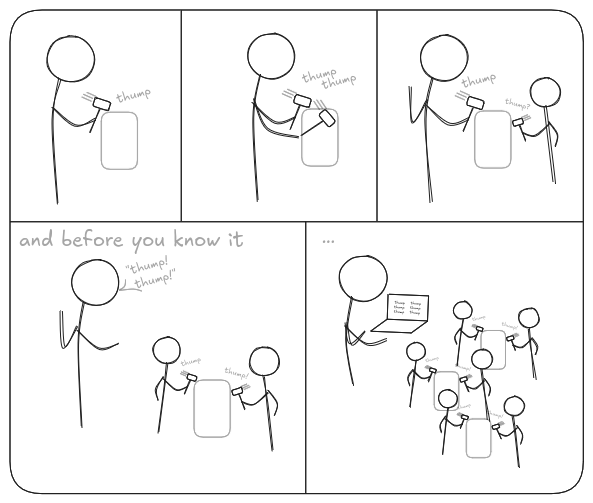
With AI, though, the metaphor holds only partially. The ten people you review learned the job from you, or from people in the field. You know roughly what they know, which means you know roughly where to look. Agents did not learn the job from you. They know less than you do about your own work, considerably more than you do about a great many other things, and there are still whole areas where they know nothing at all. And you cannot tell which is which by reading the output, because if there is one thing they are really good at, it is making it look good either way.
So steering scaled beautifully, because everyone likes giving orders and delegating. But checking did not.
Outside the few places where formal methods have genuinely taken hold, avionics, train systems, chip design, a handful of critical kernels, verification is still done more or less the way it was done thirty years ago, with a second pair of eyes, a checklist, a meeting, and a signature at the bottom of a page. All of it designed on the assumption that the amount of work to be checked would stay within humanly conceivable limits.
At Tollens, we think that reviewing and verifying is going to be the core of an enormous number of jobs over the next few years. We would like to start building the tools for that now, rather than wait for people to start drowning.
Every new tool arrives for the few first
Here is the third thing, and it is the one I feel most personally, having been on the unfairly winning side of it my whole career.
Computer scientists have had an unfair advantage for a long time now, and it has not been shrinking. Not just because they had an easy time finding work for years while many other fields were laying people off. The advantage is subtler than that, and it compounds: developers get at least six months to a year of head start on every new technology, because the first version of anything is built by the people who built it, for people like themselves. It is the only way things get built, but it means the door starts narrow.
Claude Code is the most recent example I can think of. If you have never heard of it, it is an agentic harness that lets an instance of Claude manipulate your files, look things up in a browser, and write programs on your computer. It arrived in early 2025 and it could do genuinely remarkable things.Claude Code was released as a research preview in February 2025 and became generally available that May. But it lived in a terminal, which meant that in practice it was available only to people who already lived in a terminal. I was the first to tell everyone around me that they really ought to be using it, that it was not just for programming. They tried it once, met a black rectangle with a blinking cursor, and reasonably concluded that this was not for them. Then in January 2026 the same underlying tool was introduced anew as Cowork, with a window, buttons, and a folder you can point at, and suddenly it was for everyone.Cowork was announced on 12 January 2026. The capability had barely changed. Only the interface had.
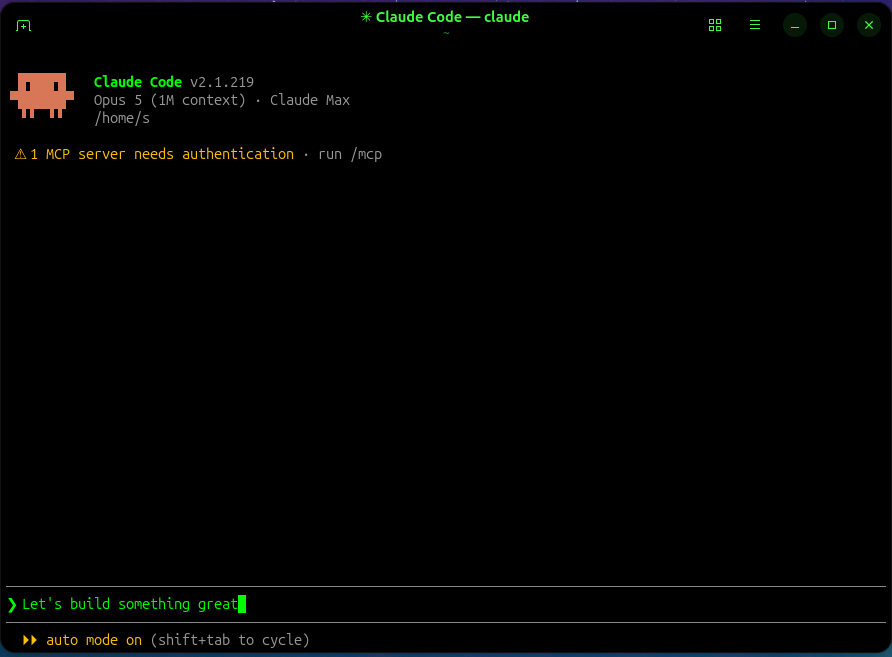
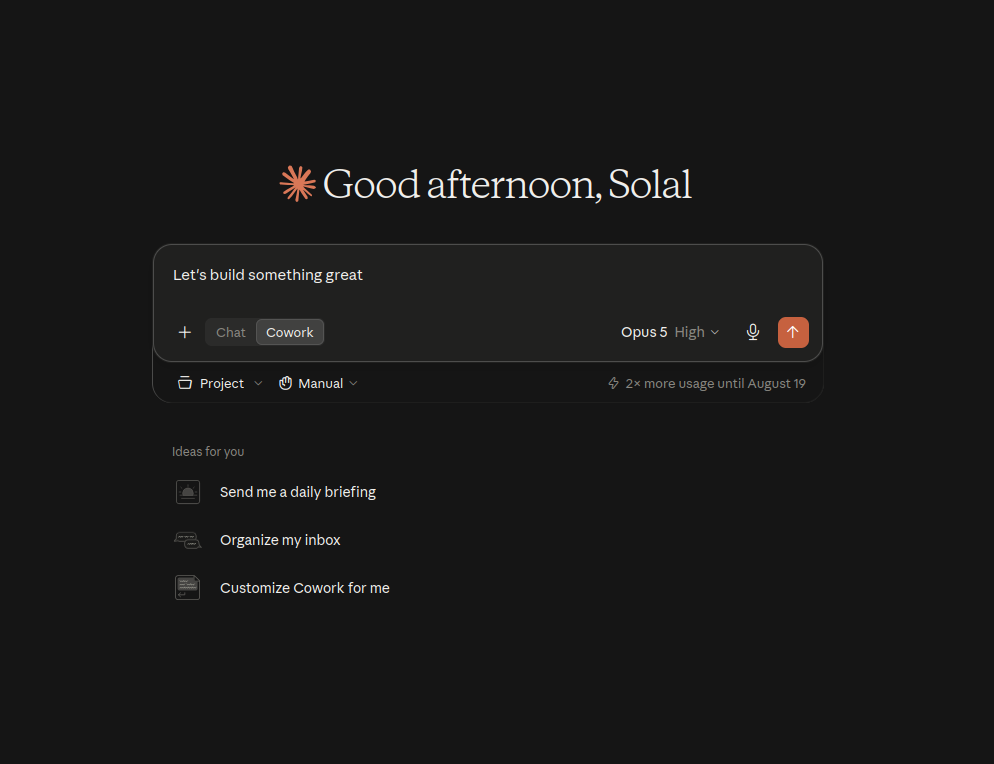
Eleven months of head start is not a small thing when it compounds, and this pattern is much older than AI. For decades, using a computer seriously at all was reserved to a small elite. That is part of why computer science has advanced at the pace it has: computer science builds its own tools. A better compiler makes it easier to write the next compiler. Better version control makes it easier to build better version control. The field has been sitting inside its own feedback loop since roughly the 1970s.
Almost no other field has that. Economics does not make economists rich enough to buy things that make them better economists. Chemistry does improve the instruments of chemistry, but on a timescale of decades. Biology, law, medicine and civil engineering all advance by using tools that somebody else built, at whatever pace those tools happen to arrive.
And then Python happened, and R, Julia, Stata and Matlab happened, and something changed quietly. The power of computation became reachable inside a curriculum, inside a notebook, in a field's own vocabulary, by people with no interest whatsoever in the internals. Today, more or less anyone in any domain can use the raw power of a computer without first doing a PhD in computer science.
The parallel seems clear to me. Formal methods have existed for about fifty years,Depending on where you start counting: Floyd's Assigning Meanings to Programs is 1967, Hoare's axiomatic basis is 1969, and Milner's LCF, the ancestor of most of today's proof assistants, is 1972. and the last decade has been a remarkable one for them, but they are still within reach of a fairly small number of people, because that is simply the way technology arrives. Python did not replace C. It made C reachable, and NumPy is still Fortran underneath, and nobody minds. That is the relationship we would like to have with the proof assistants. We would like to be the Python of verification, and to hasten that democratisation by a few years. Because if the only people who can rigorously check an economic model are the people who happen to also be able to code, then economics will have quietly outsourced its standards of rigour to a discipline that is not accountable to it. Every field should be able to be rigorous in its own terms, with its own notation, without first having to pass through ours.
So what are we actually doing?
Clinch, our first product, is a place where you write an argument down, in your own notation, and a machine checks that it holds together.
Not that it is a good argument. Not that your assumptions make sense or are relevant. That is of course your job and your expertise. But given what you said you were assuming, does the thing you concluded actually follow? Does every step of your reasoning hold, including the little appendix that everybody skims because it is obviously ok? Those questions have a mechanical answer, and the tools to compute that answer already exist. What does not exist is an interface that makes any of it legible to you, and that is the part we want to build!
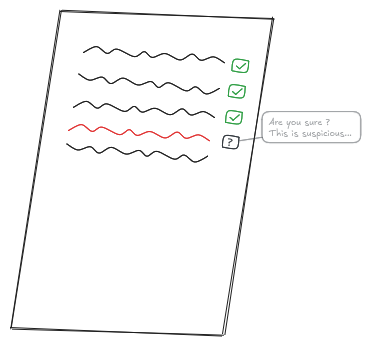
The tools that can do this today are extraordinary, and they are the reason any of this is possible at all. Rocq, Lean, IsabelleBut also Agda, Dedukti, and many more! and the solvers underneath them come out of my own field, built by people who cared about getting the foundations right for decades before anyone was asking them to. Clinch is of course not an alternative to them, we just want to keep pushing the door that has been open. Nowadays, the most well known software requires that you take on a whole logical universe before you write your first line about your own subject, because they were built by and for people for whom that universe is the subject. But that entry cost is probably why you never ran the check at all.
Practically, what we build will take the shape of a family of products, all of them doors into the same thing. A notebook you open in your browser. A plugin in a code editor, or something that sits next to your LaTeX, maybe even a way for an AI agent to hand you its reasoning in a form you can actually inspect. Which of those doors matters most is genuinely not obvious to us yet, and that difficulty is precisely why this kind of technology usually takes so long to become accessible.
Today we have a small prototype. It checks logic, arithmetic, and statistics, and it reads text written in a grammar we can extend without much trouble to match the notations of physicists, economists or biologists. It is modest, but it is the piece everything else stands on. Most of our time right now goes into finding the people who could benefit from it, and who are willing to tell us how they actually work, what they actually do, and what being sure currently costs them. Then we build a version of Clinch for their case and see whether it helps.
So, that is what I am doing these days. It still takes a while to explain, but hopefully you get a clearer picture 🙂
If any of this rang true, if part of your work involves being right and avoiding mistakes, if you work in formal methods, or if you are even just curious, I would very much like to hear from you! For a coffee if you are nearby, or a call if you are not!