
Trust is permission to stop checking
You have trusted the floor under your feet a few thousand times today.
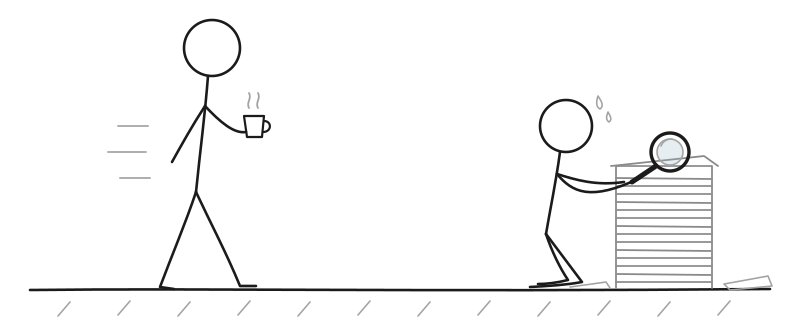
Every step, you put your whole weight on it without looking twice. You didn't test it this morning, and you didn't ask anyone whether it would hold. And it is only right that you trust it: it almost never disappoints.
Keep that image in mind while I sketch the other half of the picture: right now, an AI is probably writing a thirty-page contract that someone will sign, with about as much time to check it as you had to check the floor. Should they trust it?
I think this points toward a nice description of trust: permission to stop checking. And trust, defined as such, is what holds together lives, companies, even societies. But this definition is still quite abstract. So, what is trust? How do we build it? How do we lose it?
A disclaimer: as I write this, I am working at Tollens, a soon-to-be company whose whole business is about trust. While this post looks like an essay, you are reading about trust from someone who sells it. Calibrate accordingly, we really want to earn your trust.
Is the floor a friend?
Saying "I trust the floor" is a bit of a shortcut. What you really mean is: I trust the floor to hold me. You would trust it about 100% for that, but you would not trust it, for instance, to keep a thief out. That's the job of your door, or of security. The floor is a very simple thing, with a very narrow job, and it does it extremely well.
Trust is never just about a thing or a person. As Russell Hardin put it,In Trust and Trustworthiness (2002), the political philosopher Russell Hardin made this three-part structure ("A trusts B to do X") central to his account of trust. trust always has three parts: I trust someone to do something. Two more examples:
- Trusting a colleague to do good work means you can overlook the intermediate steps they take. You know the result they provide will convince you.
- Trusting a friend, for some, is about knowing that they will be there when it matters, that they will try to understand you, and act in your interest as best they can. That's a much more complex job, and accordingly friendships take years to build, while your trust in the floor took maybe a few hours or days, back when you were crawling and babbling.
I find it helpful to think of trust as a dial, to set separately for each job. At 100%, I don't need to supervise anything. That's the trust I would place in a co-founder, for instance. At 0, I check everything myself. That's the trust I'd put in AI-generated code when it touches the certifier.The part of our product where errors are not acceptable. And the dial goes below zero: negative trust means you expect the other party to work against you, so you check them even more carefully than a stranger.
All of this matters very much because checking is expensive, and redundant. Every time you can trust, you can delegate, and only then does it become possible to build things bigger than what you could do alone. As the economist Kenneth Arrow put it: "virtually every commercial transaction has within itself an element of trust."Kenneth Arrow, "Gifts and Exchanges," Philosophy & Public Affairs, 1972. He continues: "much of the economic backwardness in the world can be explained by the lack of mutual confidence."
So where does trust come from?
Thinking about it, we found four mechanisms through which trust is built. Feel free to pause here and guess them before reading on!This is not something we invented, but it doesn't come straight from the literature either. We find it useful to rebuild our concepts from scratch, to make sure we really understand what we're talking about. If we're making mistakes or looking through the wrong lens, please write to us, we're always eager to learn more!
1. Trust through social proof
Your parents always ate this or that, so you trust it's good for you. Everyone at work uses Claude, so you try Claude. And it is as much about how many people trust something as it is about how much you trust them. That's how certification works: institutions you trust approve bodies, which certify brands, which you therefore trust. Many things you see, use, or say come from a long and intertwined network of borrowed judgement!
- This is maybe the most powerful lever on trust there is. But you already know how destructive it can be at the scale of a society: echo chambers, polarisation, groups drifting further and further apart.Nicky Case's short game We Become What We Behold shows this loop in about five minutes. A warning: it ends with depictions of (cartoon) violence.
2. Trust through telltale signs
The second way you decide what to trust is through heuristics: telltale signs, shortcuts that spare you the effort of genuinely considering every aspect of everything. It would be impossible to live without them, but this way of trusting is also the easiest to fool, in more ways than one:
- Learning the telltale signs is often cheaper or easier than actually reaching the quality they stand for. People who are very conscientious about their work make products that work well, durably, and look pretty. So we've learned that pretty products are reliable. This is what gives us fast fashion, and plastic things that break ten times quicker than a sturdier version.
- At the scale of a society, heuristics (like judging candidates by their diplomas, as a proxy for their abilities) tend to create misaligned incentives, and a whole new set of problems. Ironically, this is the way we should trust the least to bring us good judgement: it mostly happens subconsciously, and that gives us everything we know about bias.
3. Trust through repetition
The third way is also the most ancient and rooted one. It is one pillar of the scientific method, the raison d'être of probation periods, the reason we date for a while before getting serious, and why, when you try a new bike, you are extra cautious for the first minutes. Trust is built on the expectation that things will roughly act as they did before. To get to know them, you have to watch them, checking everything, until you get that feeling of reliability.
But this way of trusting has three drawbacks:
- It is slow, very slow.
- It only works if you're looking at the right thing, from the right angle.A common illustration of this flaw is attributed to Bertrand Russell: the chicken that is fed every morning has excellent reasons to trust the farmer, right up to the last morning. In his words, in The Problems of Philosophy (1912): "The man who has fed the chicken every day throughout its life at last wrings its neck instead."
- It is fragile, and requires some luck to build properly.For a deeper exploration of how trust is built and broken between people, see The Evolution of Trust, an interactive guide by Nicky Case, the author of the game above.
4. Trust through understanding
But there is a fourth one! You can gain trust in something by understanding it. If you know why it will do things that are aligned with you, you don't have to watch it do them many times, or rely on other people's judgement. It is not without flaws either, but it is by far the most solid way to build trust. That's why a mechanic who shows you the worn part is so reassuring. That's why a conversation with a friend after an argument does so much good. That's why we like to know people's motivations, and not just their claims. We love to understand why we should trust them, rather than just whether.
From black box to white box
These four ways to trust are different, but not incomparable. One axis we like to use goes from black box to white box. Social proof does not even need you to look at the subject: people say, you follow. With telltale signs, you need to look at the surface, then decide. Trust through repetition requires you to watch the behaviour, for longer. And understanding simply means that you are looking inside. The axis goes all the way from what we call a black box, a system you have no window into and have to trust for external reasons, to a white box (which should really be called a transparent box), a system whose inner workings you can inspect.
Trust arrives on foot
Yay! We now know how to build trust. Now, how do we keep it? Or rather, how do we lose it?
Mostly, when we do check, by accident, for an unrelated reason, or because we hear about it from someone else, and we discover a choice that is clearly misaligned with what we wanted (a poor decision, a harmful act, something said about you, a malfunction…).
And at that point, we realise that trust is asymmetrical. It is very hard to build, and very easy to lose. The Dutch have a saying for it: trust arrives on foot, and leaves on horseback.
This is also why we like the black-box-white-box axis: it works a bit like a repairability score. If your trust came from the black end, a single failure leaves you with nothing to hold on to. You only had social proof, and now you have nothing. At the other end of the spectrum, if your trust came from understanding, a failure is something you can explain. It is usually located in one narrow place, and just needs a fix before you can trust the whole thing again! Trust built on understanding bends where the other kinds would break.
And life goes on
Social proof isn't that reliable, but it mostly does the job. You do as you've seen others do, sometimes you make mistakes, and life goes on.
Telltale signs can be abused, but mostly they suffice. You make friends that you trust, you buy things that you trust, sometimes you get scammed, and life goes on.
Repetition is slow, but from dating to hiring, we rely on it anyway, and life goes on.
For thousands of years, these mechanisms were tuned to a world of villages: a few dozen people whose word you could weigh, things you could hold in your hands, news that took weeks to arrive.
Then, in barely twenty years, technology rewired every one of them.
Social networks turned social proof into a scoreboard. Likes, shares, follower counts, in real time: a giant, round-the-clock scoreboard that rewards grabbing attention more than telling the truth. On Twitter, false stories were found to spread six times faster than true ones, because they were more surprising, more shocking, more emotional.Vosoughi, Roy and Aral, "The spread of true and false news online," Science, 2018. Falsehoods were 70% more likely to be retweeted than the truth, and the result held after removing bots from the data.
Telltale signs went the same way. Filters, templates, no-code tools, stock photos, ever better editing software: all of that made polish available to everyone. Today everything looks professional, and looking professional means less and less.
And repetition has been gamed by… repetition. A statement you've heard several times feels truer, even when you already know it's false.Psychologists call it the illusory truth effect, first described in 1977. Fazio and colleagues showed in 2015 that it works even when people know the right answer ("Knowledge does not protect against illusory truth," Journal of Experimental Psychology: General). For most of history, hearing the same thing again and again meant that many people, independently, had found it worth repeating. Not anymore: there's an idea in marketing that how often people see your ad, on as many channels as possible, matters at least as much as how good the ad is.
None of this needed bad intentions. These mechanisms were built for a slow world, and the world stopped being slow. All of those things changed too quickly, and the impacts were awful.
Then came AI
Now we have AI, and we, at Tollens, want to anticipate its effects and start building walls before all of those things happen again.
AI plays on all four levers, at an unprecedented scale.
- Social proof is skewed. Everyone has to use AI to stay competitive, no matter how much they trust it. You see everyone using AI, so you start trusting it.
- AI does superficial things astoundingly well, so heuristics mean nothing anymore: any agent can build a website so pretty that you start trusting your own project, even if you know you haven't built anything behind it yet. And agents are trained to be pleasing, to inspire confidence, and to maximise metrics that will make you give them more information, more data, more trust.In April 2025, OpenAI had to roll back an update to ChatGPT that had become so eager to please that it praised almost anything its users said. Their own explanation: the update leaned too much on short-term feedback, the thumbs up and thumbs down.
- Repetition is embedded in the way chatbots and agents are designed: they are there every day, always available, always patient, always agreeable.
- That leaves understanding, the one way that is hard to fake. But it is also the one that doesn't scale: understanding takes time, and AI produces more than anyone could ever read. As I wrote in an earlier post, steering scaled beautifully, but checking did not. Who has never had an AI write a long document, asked it for a summary, and then asked it to make the decision itself based on that summary?
Trust was already a complex matter before AI, enough that we had been thinking about launching Tollens for a few years, but AI has made the stakes dramatic, and urgent.
So what are we doing about it?
Let's go back to the thirty-page contract.
Say an AI, or a tired colleague drafted it, and you're the one signing. Honestly, you don't care about most of those pages. You care about a handful of things: that the lines add up to the agreed price, that every deadline in the annex falls before the final delivery date, that late penalties never exceed 10% of the price. And more generally, that everything is coherent. Three explicit questions, and a plethora of background checks you do subconsciously. Today, the only way to know they hold is to read all thirty pages, and, even more painful to read them all again every time the draft is revised.
We think that it could look way better:
- You write down your three questions, in words you understand, close to the way you'd ask a colleague about it. That's the part only you can do, because only you know what matters.
- The AI translates the contract into a language a machine can check. Or ideally, it was written into it in the first place. That part an AI can do, because even if it makes mistake, they will be caught.
- A checker goes through every clause. For each rule it either answers ✓, or points at the exact place that breaks it: "Annex B, item 4: delivery on 14 March, after the final date of 1 March."
This part is tricky to explain. The core mechanic is that you no longer need to read the twenty-nine and a half pages where nothing goes wrong. You just need to ask the questions explicitly, and read the conclusion of the checker. If anything, anything at all is even slightly unrigorous, it won't let it go unspotted.
Why trust the checker? Because you can poke at it. Because the checker will never hide complexity on which your trust should hold. You can, if you want to take the time, genuinely understand it. Because it is the part that contains no AI. Everything is auditable, the reasonning made clear, deterministic. It is but a small piece, deliberately boring, and built on formal methods, the same idea that lets you trust Pythagoras' theorem without measuring every right triangle in the universe. Once something is proved, it holds for all of them. (And mathematics never disappoints. Well, it did once,For decades, mathematicians built on a rule that seemed too obvious to doubt: any property you can describe defines a set. Then, in 1902, Bertrand Russell (yes, the one with the chicken) pointed at the set of all sets that don't contain themselves: does it contain itself? Either answer is a contradiction, and so the foundations everyone had trusted turned out to be inconsistent. Gottlob Frege, who had spent years building arithmetic on them, replied: "arithmetic totters." Mathematicians rebuilt the foundations more carefully, and these have held ever since. but it is still the sturdiest thing we have in this ever changing world.)
That's Clinch, our first tool. Today it is a prototype that checks reasoning: logic, arithmetic, statistics. Contracts, schedules and forms are where we want to take it next.
What's your thirty-page contract?
The one question we think you should be asking today is this one:
Between the floor, the contract, the report, the work of your interns, and the AI summary, in this ever-accelerating world, what should you trust, and what should you not?
We'd genuinely love to hear your answer. And since this whole post argues that you shouldn't take anyone's word for things, ours included, we'd love to hear where you think we got it wrong, too. Write to us 🙂
Next in this series: Say it back, on the other half of trust.